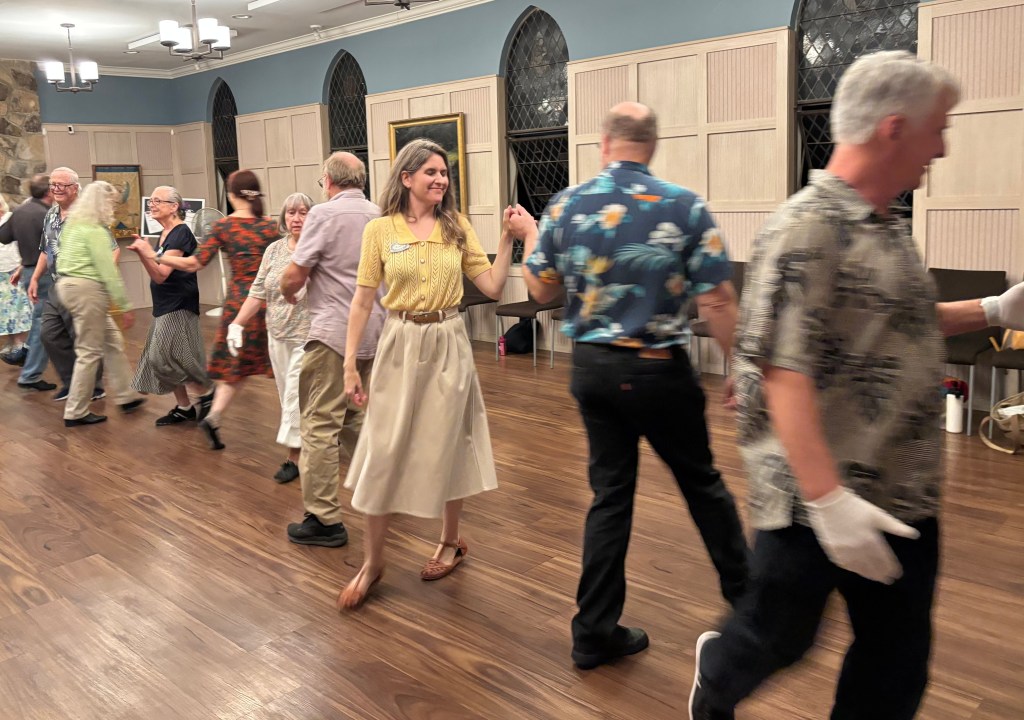
English Country Dance (often referred to as ECD) is a fun, friendly, community form of dance that originated in England during the Renaissance (if not even earlier!) It evolved and changed but stayed popular well into the 19th century, and in that stretch of time thousands and thousands of different English country dances were published, with (mostly) different tunes and (mostly) different figures.
Then ECD fell out of fashion, only to be revived in the early 20th century by Cecil Sharp and many others, spurred by the turn-of-the-century folk revival. When these folks brought back ECD, they danced dances from many different periods, and eventually folks started writing new English Country Dances. That means our current repertoire starts mostly in 1651 (though some dances are far older) and goes up through 2025!
Typically, each English country dance has its own tune (which can be slow, fast, or in-between; lyrical or rowdy or wistful….or pretty much anything else that music can express! A typical evening will have perhaps 7 – 12 different dances done, and each is individually taught and walked through and prompted at Monrovia ECD (and most other ECD communities). After the teaching and walkthrough, each dance will generally take about 3 – 10 minutes to dance.
Each dance is made up of a series of different figures, in its own particular order. Figures can be as simple as “right-hand turn your partner”, but can grow far more complicated in the more challenging dances. All figures are taught in our class, and dancers quickly learn the meaning of figures like “back to back” and “cast down.”
Typically, a dancer has a different partner for each dance (though in a few dances one has no partner, and in some one has multiple partners). A set will be made up of multiple pairs of partners, which means that everyone ends up dancing with everyone in the room in some way…it’s very social! It’s a very comfortable sort of dancing for folks who come solo, because everyone dances with everyone.
If you still can’t picture what we’re doing, think of the sort of dancing you see in Jane Austen movies, or picture a more sedate (and less twirly) version of square dancing.
Please join us!
 Monrovia English Country Dance